Does heat reduce solar panel performance? What happens in summer
Solar panels lose 0.4–0.5% of their power for every degree above 25 °C. We explain why and what you can do in summer.
Quick summary
- Silicon panels lose 0.4–0.5% of their power for every °C the cell rises above 25 °C [1].
- In real use, most modules operate at about 40–45 °C under reference conditions (NOCT) [2].
- Roof-integrated panels with no rear ventilation can run 10 °C or more hotter [2].
- Even so, July is the most productive month in Tarragona, because the radiation outweighs the heat [3].
It sounds like a contradiction: solar panels need sunshine, but they don't like heat. As the cell temperature rises, its voltage drops, and so does the power it delivers. That is why, on an August afternoon in Tarragona, overheated panels produce less than their specifications say.
The 25 °C on the label
A panel's rated power (for example, 450 W) is measured under standard test conditions (STC): 1,000 W/m² of irradiance and a cell temperature of 25 °C. On a roof, in the sun, the cell is almost always hotter than that.
How much is lost per degree
According to PVEducation, the leading educational resource on photovoltaics, the maximum power of a silicon cell falls by 0.4–0.5% for every °C of temperature increase [1]. On your panel's datasheet it appears as the "temperature coefficient of Pmax".

| Cell temperature | Approximate power |
|---|---|
| 25 °C (standard conditions) | 100% |
| 45 °C | ≈ 90–92% |
| 65 °C | ≈ 80–84% |
We clean early in the morning or at dusk, with the panel cool, to look after your modules.
Online quote calculatorThe real operating temperature (NOCT)
Manufacturers also state the NOCT: the temperature the module reaches with 800 W/m² of irradiance, air at 20 °C and wind at 1 m/s. Most modules are around 40–45 °C [2]. In the height of a Mediterranean summer, with more radiation and air at 30 °C or more, the cell gets considerably hotter.
What you can do to keep your panels cooler
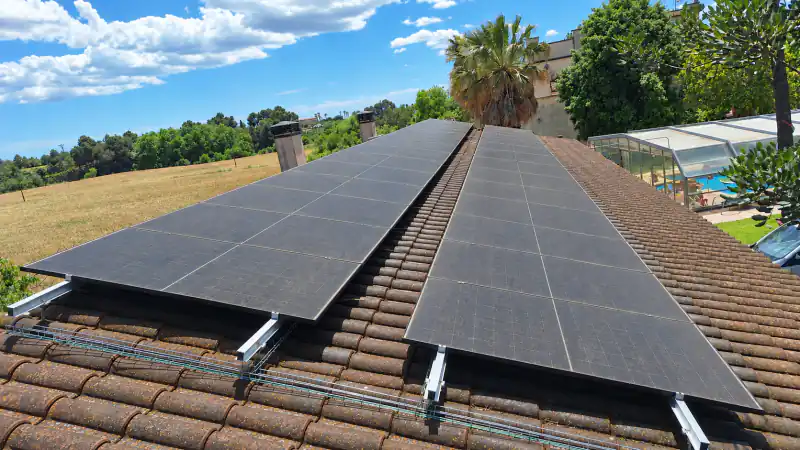
- Rear ventilation. PVEducation notes that roof integration, which blocks heat exchange at the back, can raise module temperature by 10 °C or more [2]. Let air flow under the panels.
- Keep them clean. Dirty areas or droppings heat up more than the rest and can create hot spots.
- Keep the space underneath clear. Leaves, nests or debris under the structure restrict ventilation.
Take care when cleaning in summer
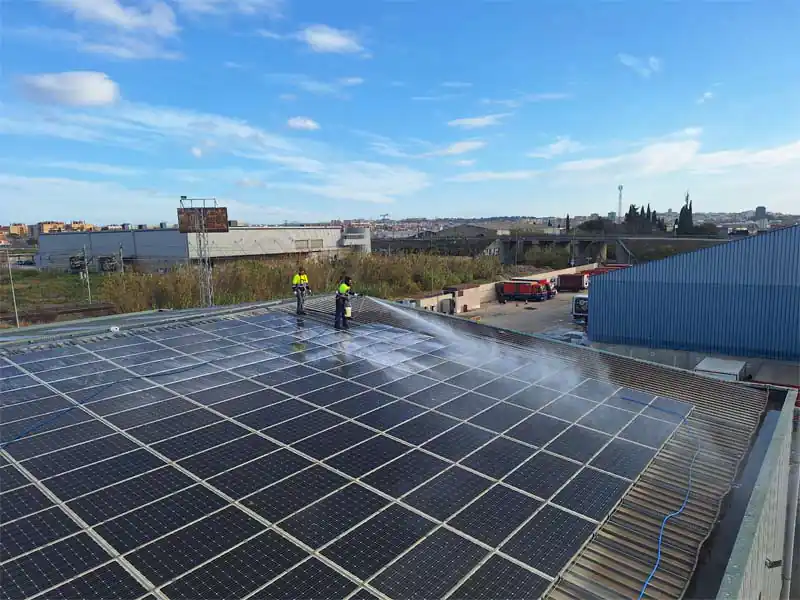
Throwing cold water on an overheated panel causes a sudden temperature change. First Solar's guidelines say not to apply water more than 20 °C warmer or colder than the module surface, and to clean in low light [4]. That is why, in our solar panel cleaning service in Tarragona, Reus and the rest of the province, in summer we work early in the morning or late in the day.
About the sources: the water quality, pressure and temperature figures in this article come from the cleaning guidelines of First Solar, one of the largest US manufacturers of solar modules, which makes thin-film modules; silicon modules, more common on rooftops, may have slightly different specifications. Each manufacturer publishes its own, which is why at TARRAMED we always follow those of your panels' manufacturer.
Want us to take care of it?
At TARRAMED, in summer we clean early in the morning or late in the day, with the panel cool and respecting the maximum temperature difference manufacturers specify. That way we clean without risk to the glass and without you losing output during peak hours.
TARRAMED, cleaning company in Tarragona
We are a cleaning company in Tarragona specialising in solar panel cleaning, industrial cleaning and technical and high-access cleaning. We work in Tarragona, Reus, Valls, Salou, Cambrils, El Vendrell and the whole Camp de Tarragona area, and travel to Barcelona, Lleida and Girona, as well as Aragon and Biscay. We clean with purified water, with a fixed quote, a photo report and a written guarantee.
References
- PVEducation. Effect of Temperature. pveducation.org
- PVEducation. Nominal Operating Cell Temperature. pveducation.org
- European Commission, Joint Research Centre. PVGIS, calculation for Tarragona, 1 kWp, optimal tilt 38°. re.jrc.ec.europa.eu
- First Solar (2017). PV Module Cleaning Guidelines, PD-5-804 Rev 3.4. firstsolar.com
Want us to check your solar panels?
We assess your installation and give you a realistic estimate of the performance you can recover, with no obligation.