Bird droppings, nests and Saharan dust: how they affect your solar panels
A single dropping can affect a whole module, and Saharan dust reduces output even before it settles. We explain why and how to protect your installation.
Quick summary
- Bird droppings reduced the performance of a PV system by about 7.4% in an experimental study [1].
- Localised shading can cause hot spots: the covered cell heats up and can be damaged [2].
- Saharan dust mainly reduces direct radiation [3]. During very intense events, output in Spain fell by 16.3–19.8% [4].
- Bird-proofing mesh stops pigeons from nesting under the structure.
Bird droppings: small, but very harmful
Dust forms a more or less even layer. A dropping, on the other hand, is an opaque patch that almost completely covers one or more cells. Because the cells in a module work in series, the one receiving less light holds back the rest.
A study published in Sustainability analysed the effect of dust, water droplets, droppings and shading separately. Droppings reduced system performance by about 7.4%, and partial shading had an even bigger effect: covering a quarter of the module cut power by 33.7% [1].
The danger of hot spots
When one cell is shaded while the rest are still in the sun, it stops producing and starts behaving like a load: it turns its neighbours' energy into heat. This is known as a hot spot. Researchers at the Politecnico di Milano reproduced this phenomenon and confirmed it with a thermal camera on a real installation [2]. If it keeps happening for months, it can degrade the cell, damage the solder joints or mark the panel permanently.
Tip: don't leave a dropping on the panel for weeks. First Solar's guidelines allow these spots to be cleaned locally with a soft cloth and water [5]. If the panel is on the roof, it is better left to a professional.
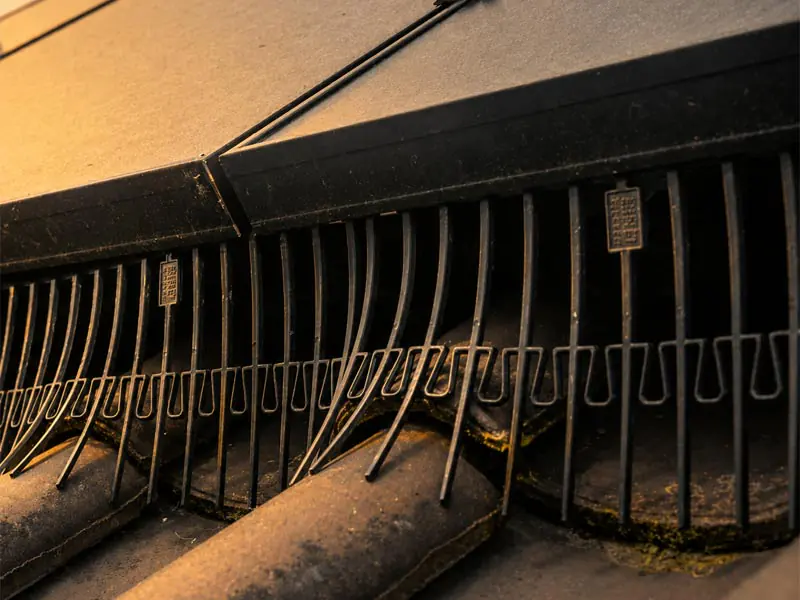
We install bird-proofing mesh on any type of installation, right after cleaning.
Online quote calculatorPigeons nesting under the panels
The gap between the panels and the roof is a perfect shelter for pigeons: it is shaded, protected from the wind and high up. The result is a build-up of droppings, feathers and nest debris right under the installation and in the gutters, plus constant dirt on the panels themselves.
The most effective solution is to close off the perimeter with bird-proofing mesh: a physical barrier that prevents access without harming the birds or drilling into the modules. Ideally it should be installed right after a clean, so the area is left free of debris.
Saharan dust: two effects in one
The "calima" is Saharan dust suspended in the air. It affects your panels in two ways:
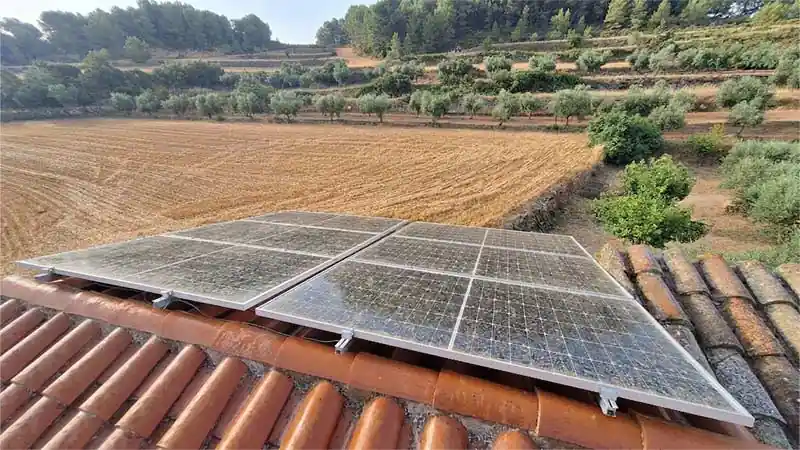
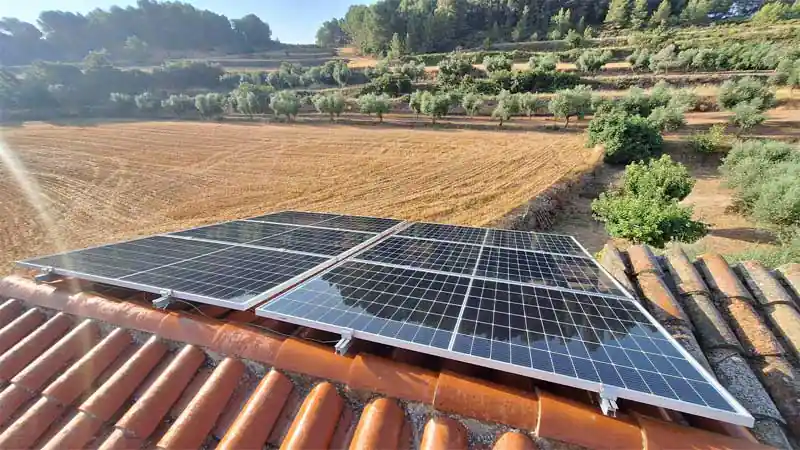
- While it is in the air, it blocks and scatters sunlight. A University of Jaén study of the March 2022 dust event found that direct radiation was the most affected component [3]. A study published in Renewable Energy covering events from 2019 to 2023 estimated that, with extremely high dust concentrations, output in Spain fell by 16.3% to 19.8% [4].
- Afterwards, it settles. If it coincides with rain, you get the well-known "muddy rain", which leaves a layer of fine dust stuck to the glass.
The first effect cannot be avoided, but the second can: after a dust event with muddy rain, it is worth inspecting and cleaning the installation.
What to do in each case
| Problem | What to do |
|---|---|
| Occasional droppings | Spot-clean as soon as possible |
| Lots of droppings or birds landing every day | Full clean and consider deterrents |
| Pigeons nesting underneath | Clean and fit bird-proofing mesh around the perimeter |
| Saharan dust with muddy rain | Inspection and cleaning with purified water |
About the sources: the water quality, pressure and temperature figures in this article come from the cleaning guidelines of First Solar, one of the largest US manufacturers of solar modules, which makes thin-film modules; silicon modules, more common on rooftops, may have slightly different specifications. Each manufacturer publishes its own, which is why at TARRAMED we always follow those of your panels' manufacturer.
Want us to take care of it?
At TARRAMED we install bird-proofing mesh on any type of solar installation, whatever the roof. It is normally done right after cleaning, to close off the perimeter without leaving nest debris or droppings behind. We have universal metal anti-bird mesh in several sizes, which adapts to the height of each structure. We recommend whichever fits your installation best.
TARRAMED, cleaning company in Tarragona
We are a cleaning company in Tarragona specialising in solar panel cleaning, industrial cleaning and technical and high-access cleaning. We work in Tarragona, Reus, Valls, Salou, Cambrils, El Vendrell and the whole Camp de Tarragona area, and travel to Barcelona, Lleida and Girona, as well as Aragon and Biscay. We clean with purified water, with a fixed quote, a photo report and a written guarantee.
References
- Mustafa, R. J., Gomaa, M. R., Al-Dhaifallah, M. and Rezk, H. (2020). Environmental Impacts on the Performance of Solar Photovoltaic Systems. Sustainability, 12(2), 608. mdpi.com
- Dolara, A., Lazaroiu, G. C. and Leva, S. (2016). Hot-spot phenomenon in PV systems with overhead lines partial shading. U.P.B. Scientific Bulletin, Series C, 78(4). re.public.polimi.it
- Molina Lorite, J. Á. (2023). El impacto de la calima de marzo de 2022 sobre la radiación (the impact of the March 2022 Saharan dust event on solar radiation). Master's thesis, University of Jaén. crea.ujaen.es
- pv magazine (2025). Saharan dust events can reduce PV power output in Mediterranean area by up to 50%, on the study "The shadow of the wind" published in Renewable Energy. pv-magazine.com
- First Solar (2017). PV Module Cleaning Guidelines, PD-5-804 Rev 3.4. firstsolar.com
Want us to check your solar panels?
We assess your installation and give you a realistic estimate of the performance you can recover, with no obligation.