Can I clean my solar panels myself? Risks, safety and warranty
Climbing onto the roof with a hose looks simple, but it means a risk of falling, of electric shock and of losing the warranty. Here is what manufacturers and the regulations say.
Quick summary
- During daylight hours, the voltage in an installation is enough to cause a lethal electric shock, according to a manufacturer's guidelines [1].
- A module with broken glass has leakage currents, and the risk increases when it is wet [1].
- Temporary work at height is regulated in Spain by Royal Decree 1215/1997, amended by Royal Decree 2177/2004 [2][3].
- Not following the manufacturer's cleaning guidelines may void the warranty on the modules [1].
If your panels are on the ground, on a low pergola or on an accessible structure, you can keep them clean yourself with some basic precautions. But in most homes, farms and industrial buildings the panels are on the roof, and that changes things. These are the three risks worth knowing about before you climb up.
Risk 1: falling
A wet tiled roof, a metal-sheet roof or a fibre-cement sheet are not designed to be walked on. Falls from height are one of the main causes of serious accidents in construction: Spain's National Institute for Occupational Safety and Health (INSST) has published a dedicated report on them [4].
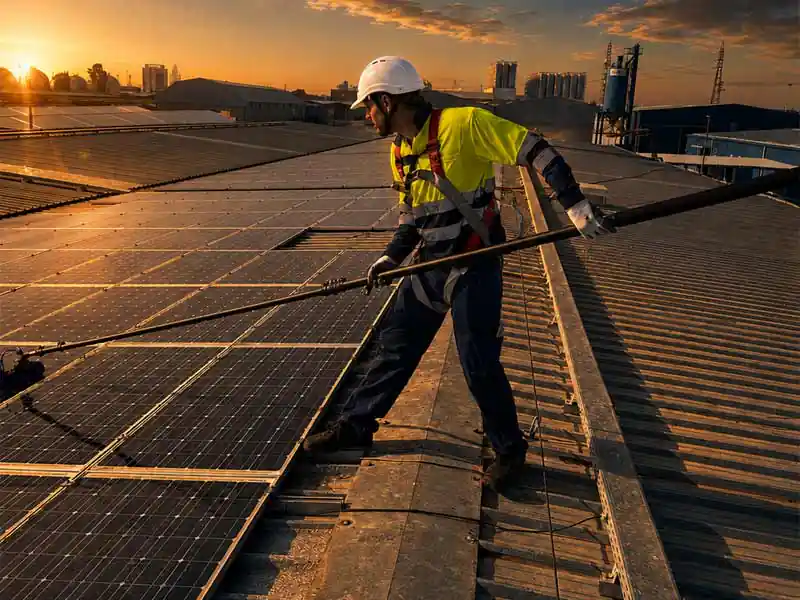
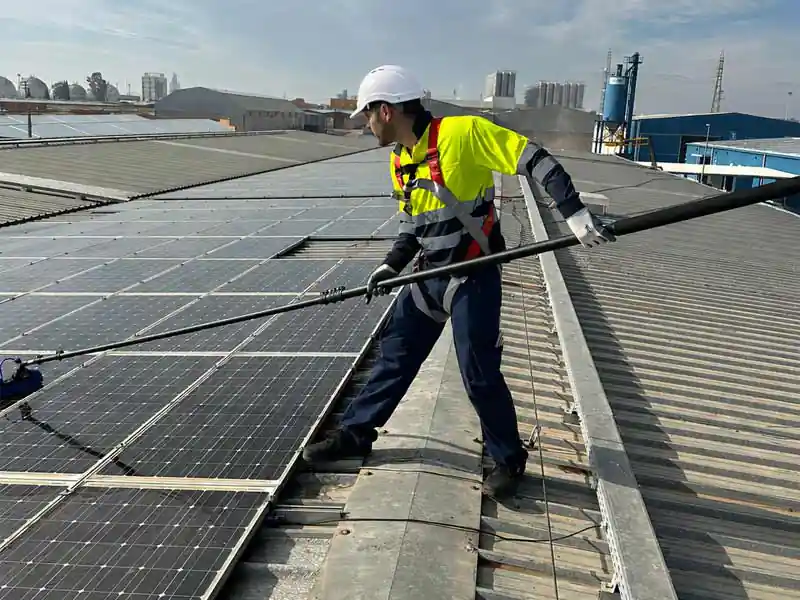
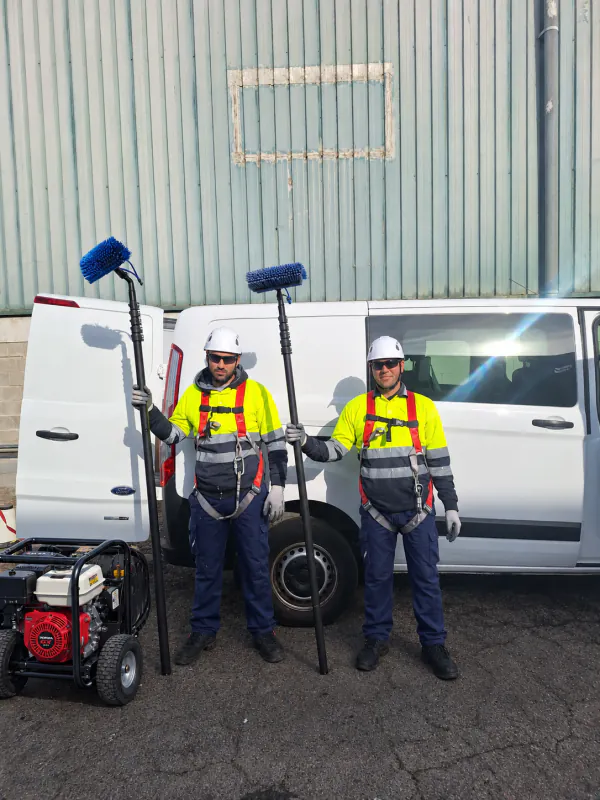
For workers, Spanish regulations require specific equipment and procedures for temporary work at height [2][3]. In practice, professional work on a roof is carried out with:
- A lifeline, fixed if the installation already has one, or portable if not.
- Certified harness and helmet.
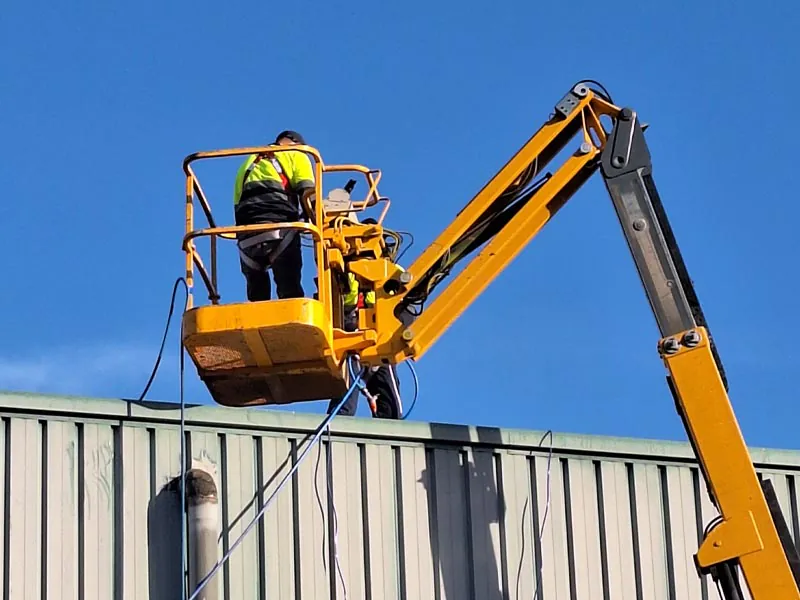
- A mobile elevating work platform (MEWP) or certified scaffolding when access requires it.
Risk 2: electric shock
As long as there is daylight, panels produce electricity, even if you switch off the inverter. First Solar's cleaning guidelines are clear: the voltage and current present in an array during daylight hours are sufficient to cause a lethal electric shock [1]. That is why the manufacturer asks for:
- Cleaning to be done only by trained personnel who understand the risks of applying water to electrical components.
- A prior inspection for cracked glass, damage and loose connections.
- Cleaning with the installation in open circuit or with the inverter off, and preferably in low light.
Are your panels on the roof? Better to send up a properly equipped team.
Online quote calculatorRisk 3: damaging the panel and losing the warranty
Solar panels come with long performance warranties, but on condition that they are installed, operated and maintained as the manufacturer specifies. In First Solar's case, its guidelines warn that failing to comply with them may void the warranty, and that modules damaged by the cleaning method are not covered [1]. The most common mistakes are:
| Mistake | Why it is a problem |
|---|---|
| High-pressure washer | The maximum recommended pressure is 35 bar at the nozzle [1] |
| Cold water on a hot panel | The difference should not exceed 20 °C [1] |
| Soap, ammonia or degreasers | They are expressly advised against [1] |
| Scouring pads or hard brushes | They can scratch the glass or its anti-reflective coating |
| Stepping or leaning on the modules | The manufacturer limits the load and requires approval for any tool resting on them [1] |
What you can do yourself
- Check production in the inverter app every month.
- Look at the panels from the ground, a window or a terrace.
- If they are at ground level, rinse them early in the morning with low-hardness water, without products or pressure.
- Call a professional if you see broken glass, loose cables, nests or a clear drop in production.
Conclusion
Cleaning panels is not difficult, but doing it on a roof is dangerous. If your installation is at height, the cost of a professional clean is small compared with the risk of a fall, an electric shock or losing the warranty on equipment that should last more than 25 years.
About the sources: the water quality, pressure and temperature figures in this article come from the cleaning guidelines of First Solar, one of the largest US manufacturers of solar modules, which makes thin-film modules; silicon modules, more common on rooftops, may have slightly different specifications. Each manufacturer publishes its own, which is why at TARRAMED we always follow those of your panels' manufacturer.
Want us to take care of it?
At TARRAMED we take care of the work on the roof: a team with certified PPE, harness and lifeline, and a mobile elevating work platform or scaffolding when access requires it. You stay off the roof and your warranty stays protected.
TARRAMED, cleaning company in Tarragona
We are a cleaning company in Tarragona specialising in solar panel cleaning, industrial cleaning and technical and high-access cleaning. We work in Tarragona, Reus, Valls, Salou, Cambrils, El Vendrell and the whole Camp de Tarragona area, and travel to Barcelona, Lleida and Girona, as well as Aragon and Biscay. We clean with purified water, with a fixed quote, a photo report and a written guarantee.
References
- First Solar (2017). PV Module Cleaning Guidelines, PD-5-804 Rev 3.4. firstsolar.com
- Royal Decree 1215/1997 of 18 July on minimum health and safety requirements for the use of work equipment by workers. BOE-A-1997-17824. boe.es
- Royal Decree 2177/2004 of 12 November, amending RD 1215/1997 regarding temporary work at height. boe.es
- INSST. Trabajos temporales en altura: caídas de altura en el sector de la construcción 2019-2023 (falls from height in construction). insst.es
Want us to check your solar panels?
We assess your installation and give you a realistic estimate of the performance you can recover, with no obligation.