How often should solar panels be cleaned? A practical guide
There is no single frequency: it depends on the surroundings, the tilt and the climate. Here is a practical guide to knowing when your installation needs cleaning.
Quick summary
- There is no universal frequency: soiling varies a lot from one installation to another, and even within the same plant [1].
- Rain helps with light soiling, but it is not enough when soiling is heavy [2].
- As a general guide, we recommend one clean a year for urban homes and two a year for farms, industrial buildings or areas with birds.
- The best time is early morning or late evening, with the panel cool and output low [2].
It is the question we are asked most often. The honest answer is that it depends, and that is not a way of dodging it: the International Energy Agency report on soiling in solar plants stresses that soiling is highly heterogeneous, both between modules and between plants [1]. Two houses on the same street may need different cleaning frequencies.
What we can do is explain what it depends on, so you know which group your installation falls into.
Doesn't rain clean the panels?
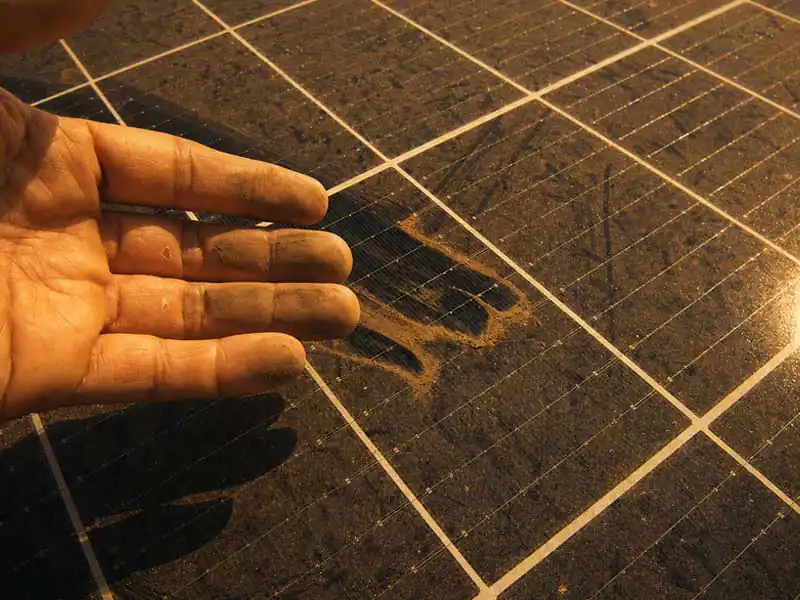
Partly, yes. The manufacturer First Solar acknowledges in its official cleaning guidelines that, for many installations, rainfall is enough to remove light soiling. But it adds that, in locations with heavy soiling, properly timed cleaning improves energy yield [2].
In the Mediterranean there are two further problems: summers are dry, exactly when the installation produces the most, and light rain does not wash the dirt away; sometimes it just spreads it and leaves a strip of mud along the bottom edge of the panel.
The factors that decide the frequency
| Factor | Why it matters | Effect |
|---|---|---|
| Farmland or building works nearby | Almost constant airborne dust | Heavy build-up |
| Industrial estate or roads | Soot and traffic particles | Greasy film that rain struggles to remove |
| Near the sea | Salt spray and seabirds | Stains and droppings |
| Low tilt (under 10°) | Rain washes dirt away less effectively | Losses close to 6% measured in summer at 8° [3] |
| Nearby trees | Leaves, pollen and resin | Partial shading |
| Saharan dust events | Fine dust deposits and muddy rain | A one-off clean is advisable [4] |
You don't have to remember: we propose a cleaning plan tailored to your surroundings.
Online quote calculatorOur recommendation by type of installation
Home in an urban area
One clean a year, ideally in late spring, before the months of highest production.
Farm, country house or rural setting
Two cleans a year: before summer and after the harvest or in autumn.
Industrial building or flat roof
Two or more a year, with an inspection of the modules, fixings and wiring.
After heavy Saharan dust
An inspection and a one-off clean if there has been muddy rain.
These frequencies are our practical, experience-based recommendation; after the first inspection we adjust the schedule to your installation.
What time of day should panels be cleaned?
First Solar's guidelines recommend cleaning in low light, from dusk to dawn or during low-production hours, when the electrical risk is lower and no energy is lost. They also say not to apply water more than 20 °C warmer or colder than the module surface [2]. That is why we never spray cold water on a panel that has been baking in the August midday sun.
Signs that it is time to clean
- Output on clear days has dropped compared with the same month last year.
- You can see white droppings or a strip of mud along the bottom edge.
- There has been a Saharan dust event with muddy rain.
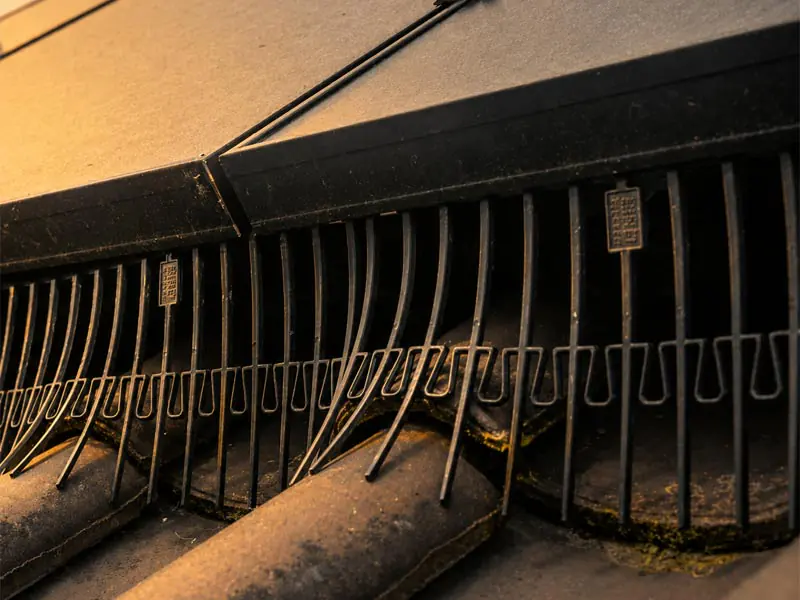
- Pigeons are nesting under the panels.
- Nobody has checked the installation for over a year.
Conclusion
Rather than fixing a date in the calendar, what matters is keeping an eye on production and knowing your installation's surroundings. If you don't have time for that, a regular cleaning plan with inspection and a photo report takes the worry off your hands.
About the sources: the water quality, pressure and temperature figures in this article come from the cleaning guidelines of First Solar, one of the largest US manufacturers of solar modules, which makes thin-film modules; silicon modules, more common on rooftops, may have slightly different specifications. Each manufacturer publishes its own, which is why at TARRAMED we always follow those of your panels' manufacturer.
Want us to take care of it?
If you'd rather not worry about the calendar, at TARRAMED we propose a regular cleaning plan tailored to your surroundings (home, farm or industrial building), with a prior inspection and a photo report on every visit.
TARRAMED, cleaning company in Tarragona
We are a cleaning company in Tarragona specialising in solar panel cleaning, industrial cleaning and technical and high-access cleaning. We work in Tarragona, Reus, Valls, Salou, Cambrils, El Vendrell and the whole Camp de Tarragona area, and travel to Barcelona, Lleida and Girona, as well as Aragon and Biscay. We clean with purified water, with a fixed quote, a photo report and a written guarantee.
References
- IEA PVPS Task 13 (2023). Soiling Losses – Impact on the Performance of Photovoltaic Power Plants. Report IEA-PVPS T13-21:2022. iea-pvps.org
- First Solar (2017). PV Module Cleaning Guidelines, PD-5-804 Rev 3.4. firstsolar.com
- Polo, J. et al. (2021). Modeling soiling losses for rooftop PV systems in suburban areas with nearby forest in Madrid. Renewable Energy, 178, 420-428. doi.org/10.1016/j.renene.2021.06.085
- pv magazine (2025). Saharan dust events can reduce PV power output in Mediterranean area by up to 50%. pv-magazine.com
Want us to check your solar panels?
We assess your installation and give you a realistic estimate of the performance you can recover, with no obligation.