Purified water for cleaning solar panels: why any water won't do
Tap water leaves limescale on the glass and a pressure washer can damage the panel. We explain which water, pressure and temperature manufacturers recommend.
Quick summary
- First Solar's guidelines say reverse osmosis (purified) water provides the best results [1].
- If tap water is used, its total hardness should be below 75 mg/L; between 75 and 180 mg/L it must be squeegeed off to prevent scale [1].
- Water pressure must not exceed 35 bar at the nozzle [1].
- No abrasive cleaners, degreasers, ammonia or hydrochloric acid [1].
When someone decides to clean their own panels, the first thing they usually grab is a hose or a pressure washer and, sometimes, a bit of soap. It seems logical, but it is exactly what manufacturers ask you to avoid. The reason is something you cannot see: the minerals dissolved in the water.
The problem with tap water: limescale
Tap water contains dissolved calcium and magnesium. Their sum, expressed as calcium carbonate, is what is known as water hardness [2]. When water evaporates on the hot glass of a panel, those minerals stay behind: they form white spots and, over time, a film of limescale that reduces the light reaching the cells. It is the same thing that happens to a shower screen, but on a surface that sits in the sun all day.
That is why First Solar's cleaning guidelines set very specific limits [1]:
| Parameter | First Solar recommendation |
|---|---|
| Type of water | Reverse osmosis: "provides the best results" |
| Tap water | Only with total hardness < 75 mg/L |
| Hard water (75–180 mg/L) | Must be squeegeed off to prevent scale. Prohibited on anti-reflective coated modules |
| Total dissolved solids | < 1,500 mg/L |
| Pressure | Maximum 35 bar (500 psi) at the nozzle |
| Temperature | No more than 20 °C difference from the module surface |
| Detergent | Only mild, non-abrasive, with pH between 6.5 and 8.5 |
| Prohibited | Abrasives, degreasers, hydrochloric acid, D-limonene, ammonia, sodium hydroxide |
What purified water is
It is water that has gone through a reverse osmosis unit: a membrane that holds back almost all salts and minerals. The result is practically pure water that leaves no marks when it dries. That is why there is no need to dry the panels afterwards or to use chemicals: the water carries the dirt away and evaporates without leaving residue.
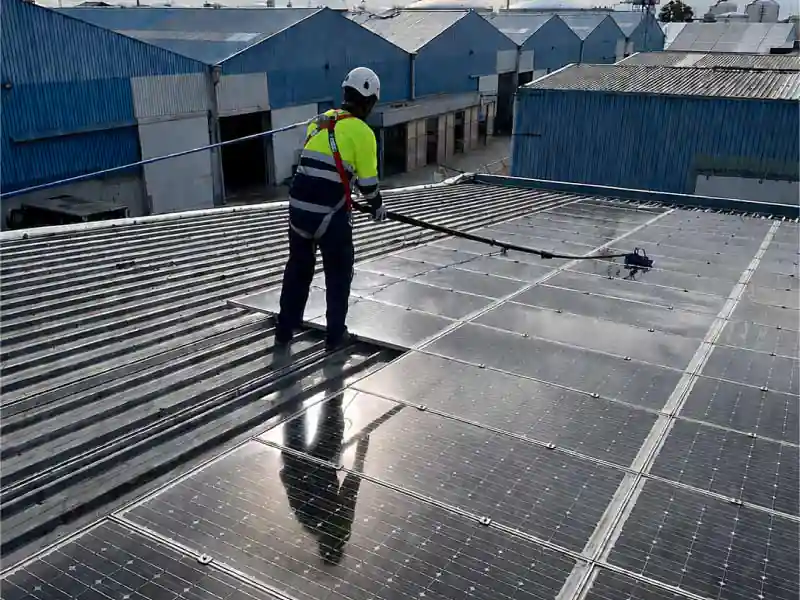
We already bring the purified water and the equipment: you only have to ask us for a quote.
Online quote calculatorWhat about pressure washers?
A household pressure washer can easily exceed the pressure recommended by manufacturers, and the concentrated jet can damage the seals. First Solar's guidelines also say not to spray pressurised water directly at the junction box, edge seals or connectors [1]. Water can get where it shouldn't and cause faults or electrical leakage.
Thermal shock
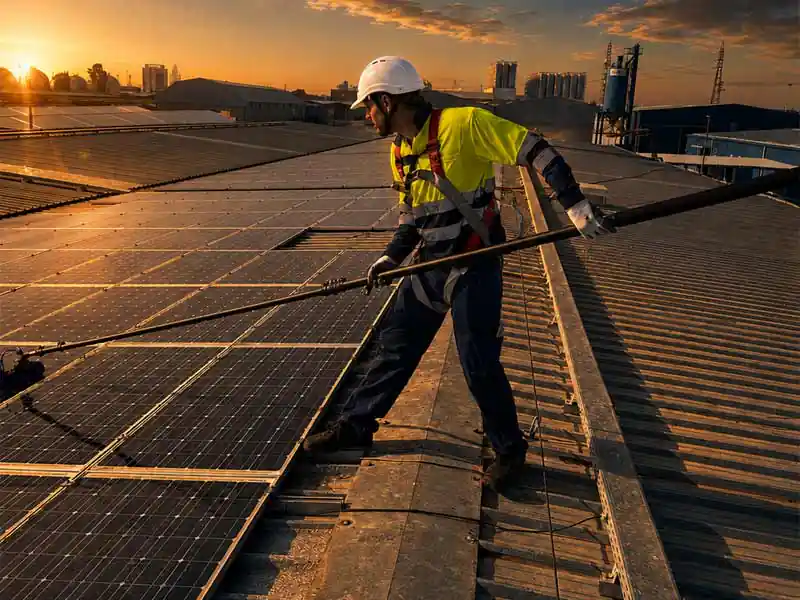
In summer, a panel in the sun can get very hot. If cold water is suddenly thrown on it, the glass undergoes a sharp change in temperature. That is why the manufacturer limits the difference to 20 °C and recommends cleaning in low light [1]. We work early in the morning or late in the day.
How we do it at TARRAMED
- We inspect the installation and check there are no broken modules or loose connections.
- We use purified water, free of salts and minerals.
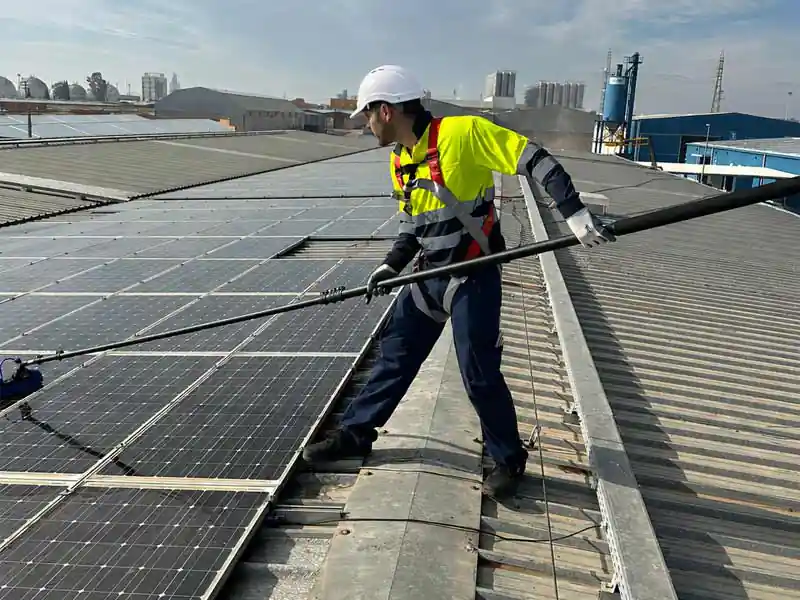
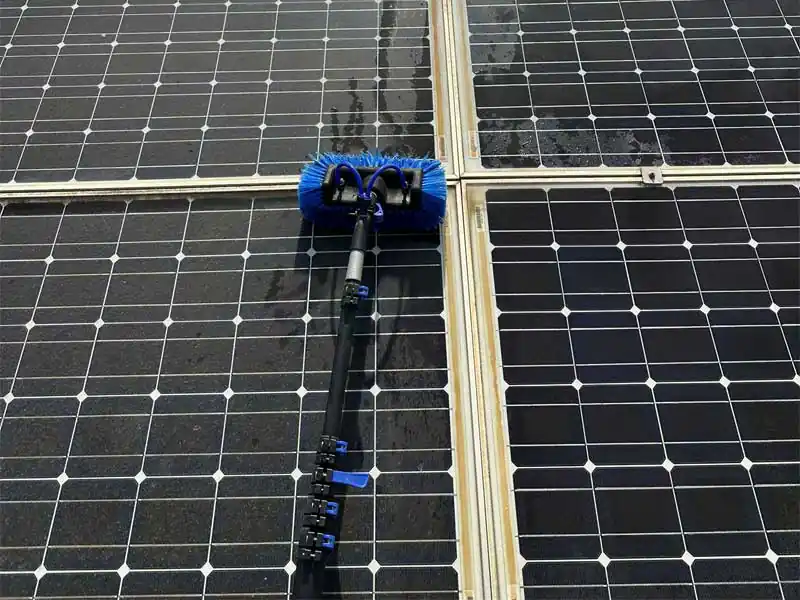
- We clean with a pole and soft brush, at low pressure and without harsh detergents.
- We avoid putting weight on the modules and follow the manufacturer's specifications.
- We give you a photo report showing the before and after.
Conclusion
Cleaning with hard water can leave panels worse than before, and too much pressure puts the warranty at risk. Purified water is the option First Solar recommends in its guidelines and the one we use: it cleans, leaves no limescale and needs no chemicals.
About the sources: the water quality, pressure and temperature figures in this article come from the cleaning guidelines of First Solar, one of the largest US manufacturers of solar modules, which makes thin-film modules; silicon modules, more common on rooftops, may have slightly different specifications. Each manufacturer publishes its own, which is why at TARRAMED we always follow those of your panels' manufacturer.
Want us to take care of it?
At TARRAMED we work with purified water, a pole and soft brush, at low pressure and following your module manufacturer's specifications, to clean without putting your installation's warranty at risk.
TARRAMED, cleaning company in Tarragona
We are a cleaning company in Tarragona specialising in solar panel cleaning, industrial cleaning and technical and high-access cleaning. We work in Tarragona, Reus, Valls, Salou, Cambrils, El Vendrell and the whole Camp de Tarragona area, and travel to Barcelona, Lleida and Girona, as well as Aragon and Biscay. We clean with purified water, with a fixed quote, a photo report and a written guarantee.
References
- First Solar (2017). PV Module Cleaning Guidelines, PD-5-804 Rev 3.4. firstsolar.com
- Whitman College. Dureza del agua (water hardness), defining total hardness as the sum of calcium and magnesium expressed as mg CaCO₃/L. whitman.edu
Want us to check your solar panels?
We assess your installation and give you a realistic estimate of the performance you can recover, with no obligation.